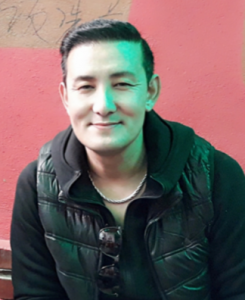
Tulku Jamyang Gyatso merges Buddhist philosophy 21 with contemporary arts to explore the issues around his community. Since childhood, Tulku Jamyang trained with his father Ugen Dorje, a renowned painter in Traditional Tibetan thangka painting. He also learned the art of calligraphy while living in the Buddhist monastery as a monk. Recognized as a reincarnated Tulku (Tibetan Buddhist master), the artist has unique life experiences of intensive monastic Buddhist practice and study, as well as international travel as a Buddhist teacher. He seeks to express the spirituality of Tibetan Buddhism in his work.
Jamyang’s art is influenced by his brother Tsherin Sherpa, a fellow contemporary artist. He further finds artistic inspiration from the works of Andy Warhol, Joseph Beuys, and Gerhard Richter.
The practice of spirituality through Buddhism has been ongoing for many centuries in Nepal. Monasteries have practiced a simple way of life parallel with changing structures of societies. Monks, who lead lives of moderation and reflection use their lives to attain spiritual clarity. Buddhist philosophy is one of our heritages it is a source of unique knowledge and understanding. My style draws upon the Buddhist philosophy as articulated in a statement from Heart Sutra: “Form is emptiness and emptiness is form.” When I use lit incense to burn forms into the paper, the emptiness left behind in effect becomes the form. I am employing destructive means in order to create my work. The five elements also inform my process: the earth is the wood (that provides the paper), the air is my breath that keeps the incense burning, the fire is the incense itself, the water is the paint, and the space is the (w)hole that is created.